GROUND PLAN OF AN EXPERT NETWORKER
JEF GEYS DEMARCATES OUTSIDE THE LINES AT S.M.A.K.
bringing to expression
the space of life in its entirety
Lucebert
Bringing to expression the entire space of art in life and the space of an entire life in art, that’s what the Jef Geys’ S.M.A.K. exhibition brings us. On the ground floor of the Ghent museum the artist unfolds his lifelong dealings with the visual arts, stretching from the earliest piece of source material far beyond the launch.
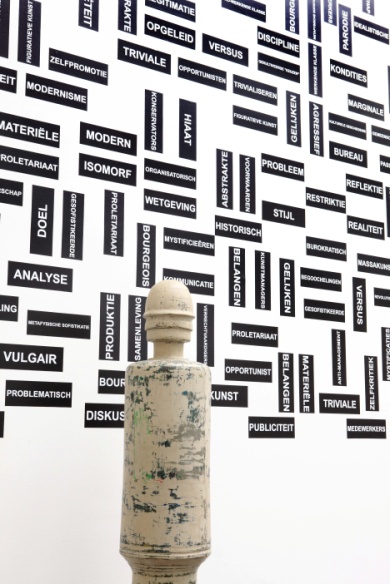
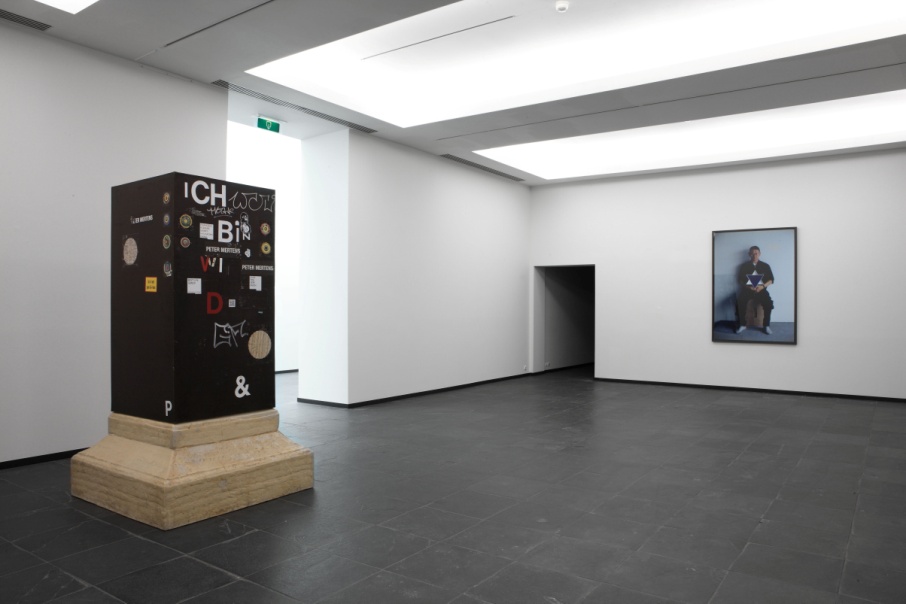
Those who enter receive a warning in the form of a peeling, cracking dummy, with artistic terms and jargon belonging to other fields written lightly in Dutch on its body and forming a powerful backdrop: ‘metaphysical sophistication’, ‘cultivated choices’, ‘trivial’, ‘isomorph’, ‘anti-hegemonic’, ‘restriction’ … . The apparent message to viewers and visitors: let go of obscure language, of making things sound complicated, and instead approach this convergence and cycle of life and art uninhibited. At the same time it is also an exhortation to yours truly.
Newspapers as raw material
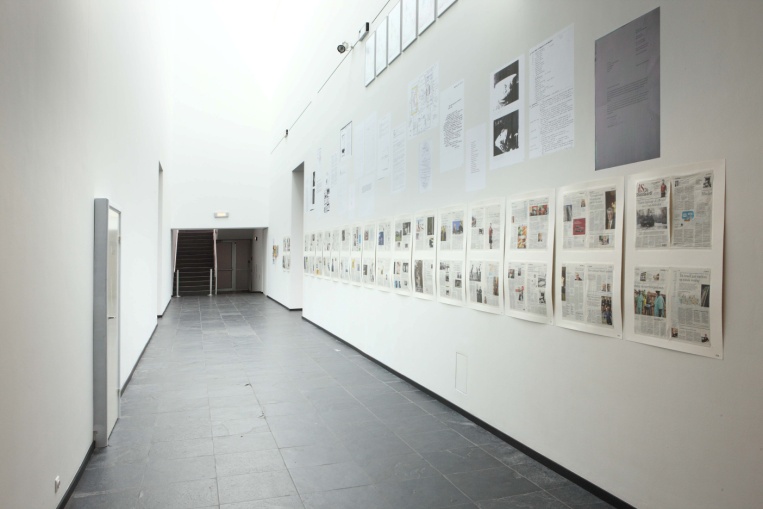
A newspaper sets the exhibition in motion. Sections of De Standaard form a frieze in the corridor leading to the gallery rooms. The artist’s reason for choosing the newspaper of 6 February 2015 is revealed in a public announcement: ‘Colouring pictures for adults. Free with De Standaard.’ Readers receive drawings by Jan Van Der Veken to colour in. This is not a new idea. Geys designed a colouring book for adults between 1963 and 1965 and regularly exhibited pages from it. In the former Mol city newspaper Molshoop he even organised a competition involving colouring in stars of David: ‘Colour the boxes as indicated … and win a trip to Benidorm’ (1986).
But it is not just this prominent parallel which explains the opener. Newspapers are primary raw material for Geys’ activities. He constructs projects from his everyday reading, using the daily papers as materials. For example he hangs job offers on exhibition walls (‘Ik zocht werk!’/‘I was looking for work!’, Antwerp 1974 and Bruges 2005), places announcements (‘Lapin rose robe bleu(e)’, Düsseldorf 1987) and sends his mother front page birthday greetings (De Morgen of 16 August 1986). Moreover the main catalogue for most of his exhibitions is a newspaper, the Kempens Informatieblad.
Artistic throwaway material
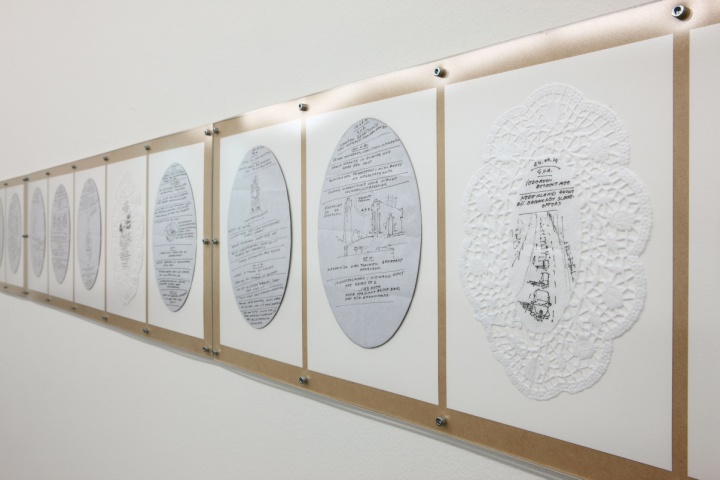
The first gallery shows what daily papers set in motion: coffee cup coasters full of headlines, illuminated with sketches. In a café in his neighbourhood Geys regularly reads the morning paper over a cup of coffee and notes down titles which catch his eye on a coaster without distinguishing people or particular points of interest, annotating them with drawings: ‘Kempenaar baas van fritkot Max’ (‘Kempen man boss of Fritkot Max chippy’) beside ‘Via netwerk naar Syrische front’ (‘Via network to Syrian front’, 10.04.14), ‘André Rieux op de Noordpool’ (André Rieux at the North Pole’) beside ‘Zee rond Fukushima nog decennia besmet’ (‘Sea around Fukushima to be contaminated for decades’, 09.08.14), ‘Sven Nijs en Isabelle uit elkaar’ (‘Sven Nijs and Isabelle split’) beside ‘Tweede Suezkanaal voor Egypte’ (‘Second Suez Canal for Egypt’, 06.08.2014) et cetera. Eighty such well-thumbed coasters from 2013 and 2014 now hang neatly behind glass in the museum. Throwaway material gains artistic value. Impulses become definitive. A cocktail of sustainability and transience to provide food for thought.
Loose ends
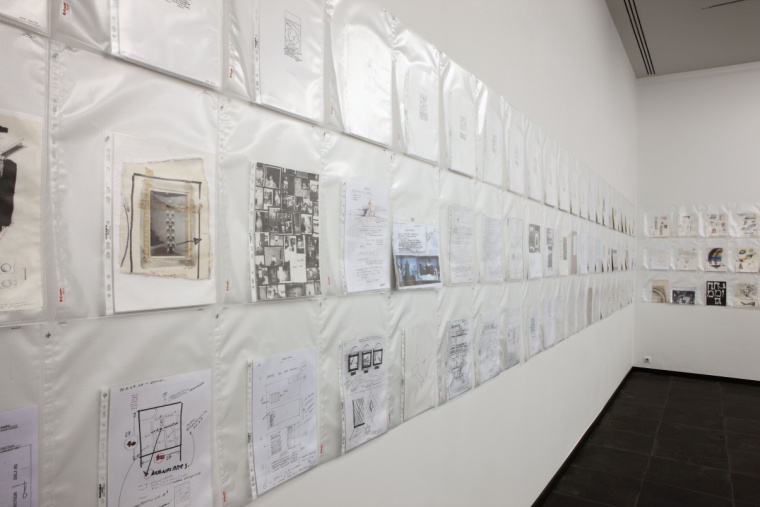
But Geys wouldn’t be Geys if he did not test the mix to the point of ultimate saturation. To him multiplicity is often an antidote to the adulation of the unique artefact. Along the same lines, he allows works of art to go on for an extravagantly long time (‘Dag en nacht en dag’/‘Day and night and day’, Documenta, Kassel, 2002), he allows others to take up the same project time and again, even beyond his death (‘Lapin rose, Robe bleu(e)’, 1986, 1987, 1988, 1992,…), his sculptures can be ordered in the desired numbers, formats and colours (‘Kleine vruchten’/‘Small fruits’, ‘Grote vruchten’/ ‘Large fruits’ s.d.), …. and so in two rooms at S.M.A.K. rows of 800 transparent folders with pieces from his archive are drawn up along eight walls. These are articles, letters, scraps of paper, mails, photos, drawings, blueprints, collages, proofs, plans, ground plans etc. connected with his life and work. Preparatory work hangs beside reactions, rejections next to expressions of gratitude, copies next to originals. What other artist ever offered more of a view of his internal kitchen? However, Geys generally only gives us loose ends, the patchwork of the work of art, project or oeuvre, leaving us to piece them together.
Art at last
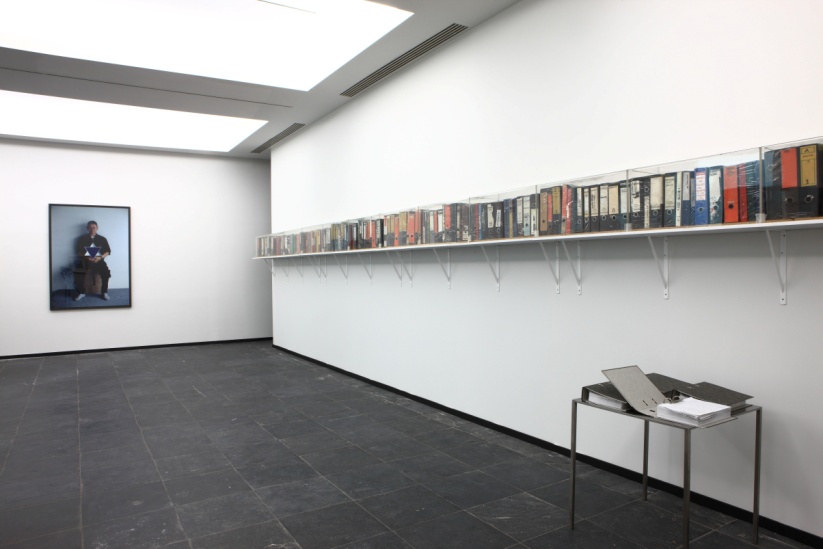
Three rooms and a corridor mainly relating to artistic conception are followed by a room with something that might currently be recognised as art. On his exhibition map the artist calls the four works ‘Stukken bruikleen’ (‘Pieces on loan’). At last museum pieces, at last art as we might hope for and expect from four important, conventional expressive domains: a painting from the Mu.ZEE, a statue from the Middelheim Museum, a photo from the M HKA and an installation from S.M.A.K.. They are undisciplined results of these disciplines: a painted seed packet, a noticeboard pedestal on a classic pedestal, a photographic self-portrait with a star of David and a shelf of hermetically sealed archive folders above a small table with archive covers available for consultation. These brief descriptions already reveal what ties the four works together.
Impact of an image
Western painting is liberally strewn with flowers and plants. Painters of all times have devoted themselves to lifelike or stylised representation of nature’s splendour. Geys, too, paints nature, but not living flora. He copies the flowers in oil paint, faithful to nature, including their names, as reproduced on a seed packet: GYPSOPHILA ELEGANS. Long before the postmodern artists of the late twentieth century – the first work of the long-running ‘Zaadzakjes’ (‘Seed packets’) series dates back to 1963 – Geys painted imitations of existing standard illustrations and posed the question of the impact of an image on its context and that of the context on the image.
Pedestal on a pedestal
Sculptors set their work on pedestals, literally and figuratively elevating the object. Geys sets the pedestal itself on a pedestal, following Didier Vermeiren, who did so in 1980. In Vermeiren’s ‘Sculpture de socle’, from the S.M.A.K. collection, an antique pedestal bears its own image on its head, leading to confusion. Who supports whom? Who elevates whom? In Geys’ case this is all too clear: the classic pedestal elevates a workaday noticeboard pillar. For six months visitors to Antwerp’s Stadspark were able to stick, write or paint their thoughts on the pillar. Geys does not simply play artistic leapfrog as Vermeiren does, but allows art to play leapfrog with everyday life.
Self-portrait in shirtsleeves
A self-portrait displays the maker as an artist, self-confident or in all his fragility, or he attempts to capture his own nature as personally as possible. In Geys’ photographic self-portrait for the São Paulo Art Biennial in 1991, he presents this take on the genre firmly in his shirtsleeves. He neither paints nor sculpts but instead photographs himself, a technique which would generally result in a forced, mechanical image. The manner in which he captures himself goes a step further. In a black overall, head-on and with dark seriousness, he poses for the camera as if for a mugshot. The entire pose breathes deathly chill and anonymity. The star of David he holds at his chest, the ultimate robber of any individual character, completes the picture and thoroughly makes a mockery of the image of the artist as a special personality and so-called sensitive hyper-individualist.
Who are we preserving for?
Installation art in itself is already the most disjointed artistic genre and puts makes it right up Geys’ street. ‘Gesloten archief (1957- …)’ (‘Closed archive (1957-…)’), the central piece ‘on loan’ from S.M.A.K., undermines and questions, not least calling into doubt the oeuvre of the artist himself.
It questions the closed archives of democratic regimes as well as authoritarian ones. Does the dominant power seek to protect the privacy of the citizen or security of the state, as they often claim, or to cover up less wholesome matters? But the hermetically sealed folders generally clash openly with Geys’ own open archive pieces from the two previous rooms and the exhibition book (‘1,2,3,… Archief Jef Geys’). Why are certain documents not available for consultation while others are put on display? The installation itself poses this question with the open covers full of archive copies on the little table under the shelf. How arbitrary or deliberate are the items exhibited, and how random or reasoned are the items saved? Why do people keep archives if they close them to themselves and others? Why preserve things and for whom? Does that process of preservation not betray a great deal of pretension and vain hope? Who will take the trouble of opening up those thousands of relics after the artist’s death? The inquiring Geys spares nothing and no one, even his own life’s work.
Conserving and exhibiting
Such questions of preservation and exhibition can also be posed of the quintessential art institution, the museum. After all, conservation and exhibition is its primary task. Geys implicitly poses this question in the four rooms surrounding the four works of art. Conception and production are followed by the reception of the artefacts he has released into the world. M HKA, the Middelheim Museum, Mu.ZEE and S.M.A.K. each have their own space showing their websites on flat screens and projecting Geys’ pieces from their collections on the wall. Each artwork is neatly numbered: 1. Museum collection, 2. On loan from Flemish Community, 3. On loan from private owner.
It was no coincidence that these four museums were selected. Together they form ‘Contemporary Art Heritage Flanders’ (CAHF), a ‘knowledge platform’ for considering contemporary collection practices. The museums scrutinise their collection methodology, positioning and identity, seeking possible forms of collaboration. Where this collaboration takes the form of meetings, lectures and publications, Geys tests the mission of CAHF in practice and brings together the museum’s collections via his work. Where is their identity in the pieces they bought or loaned from him?
Geys versus Hoet
What really interests Geys, however, is the extent to which the artist himself retains his identity amongst all the positioning of these collections. The location of the S.M.A.K. exhibition is an excellent showcase for this, as Geys has a history with this Ghent museum. A few interventions show how he defended his autonomy against the dominance of former custodian and curator Jan Hoet.
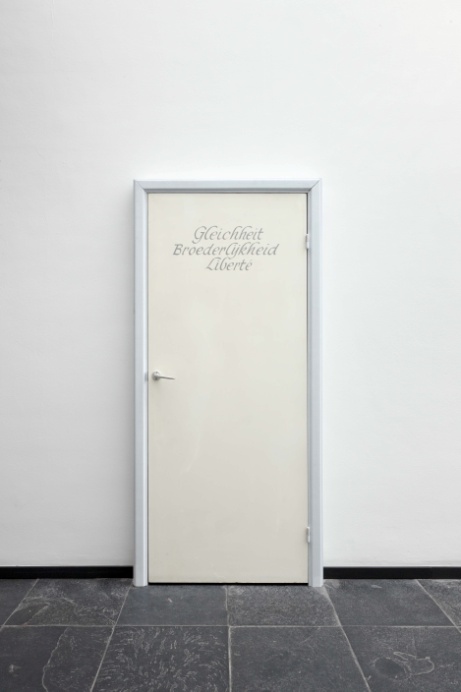
For example he refers at the beginning and end of the exhibition directly to ‘Chambres d’Amis’. Against the wall in the corridor with the newspaper is one of the doors he placed in various Ghent workman’s houses during this prestigious display in 1986. The doors had ‘Equality, Fraternity and Liberty’ written on them in different languages. Those who opened them were confronted with a blank wall. The meaning is as clear as it is confrontational. Geys was the only one of the participating artists who did not pick a rich bourgeois house for his contribution.
Head against the wall
In the last room of the exhibition visitors can watch the television documentary ‘De langste dag’ (‘The longest day’), showing the opening of ‘Chambres d’Amis’ and the exhibition running at the same time, ‘Initiatief 86’ (Initiative 86’). During this broadcast Geys and Panamarenko in conversation are highly critical of the elitist character of the event. While curator Kaspar König guides dignitaries around ‘Initiatief 86’, director Jef Cornelis also shows interventions from a town house with a blind door on ‘Gelukstraat’ (‘Happiness Street’): ‘When you enter that door, you hit your head against the wall, just as I’m always hitting my head against the wall,’ the inhabitant states. Meanwhile König pontificates further at the other location on the ‘enlightenment artist’ Jef Geys and the series ‘Zaadzakjes’ (‘Seed packets’), which the artist hung in a bare, unrestored room in St Peter’s Abbey, Ghent.
No money
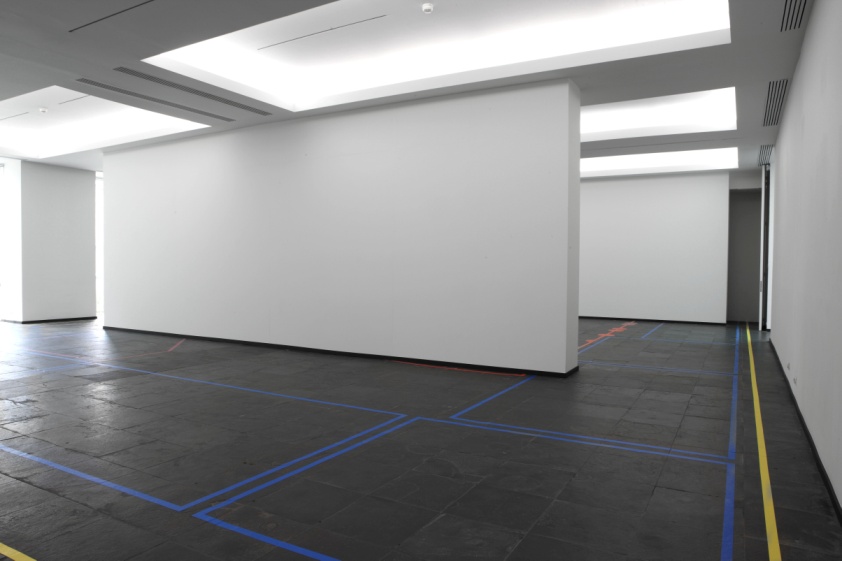
The most succinct item connected with this museological theme is undoubtedly the intervention which takes up a large part of the left wing of S.M.A.K.’s ground floor. The rooms are empty. Only the floors are marked with lines running through in four colours. Together they form the ground plan of the semi-circular room at Ghent Museum of Fine Arts, opposite S.M.A.K., the institution which housed the contemporary collection before 1999. Geys was to exhibit there in 1980, but, despite the fact that his ground plan was already well under way, Jan Hoet called it off.
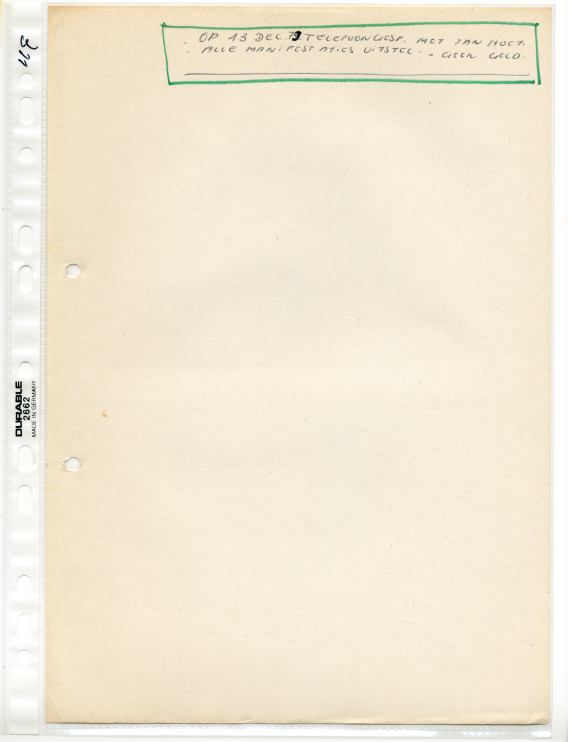
A note from the accessible archives indicates the probable reason: ‘13 Dec 1979, phone conversation with Jan Hoet. All exhibitions postponed – no money’ (no. 311). In a letter dated four days later (no. 787), Geys explicitly asks Hoet for his position, ‘personally and (/or) as director’, on the cancellation. If ‘financial difficulties’ are really behind it, he would like to see it proven by the minutes of a meeting of the ‘organising board’. It is unclear whether an answer ever came, but in a letter dated 10 January 1981 the artist thanks the curator for the purchase of ‘a piece’, in the same breath stating, ‘of course I retain my position as regards earlier letters addressed to you on the cancellation of the planned exhibition “Jef Geys in the museum of contemporary art – Ghent 80”. If that position had to cost me 100 000 francs then that is certainly pricy, but in any case…’ (no. 789). Geys’ autonomy is clearly worth a great deal to him…
Exhibition as Gesamtkunstwerk
In this way the phenomenon of the exhibition, albeit in ‘cancelled’ form, is a significant part of the show alongside other components of the art world already mentioned. And, more importantly, the exhibition is not only a work of art as a component. In its entirety, too, the skill lies in the way Geys has woven a creation on the lower floor of S.M.A.K., perhaps even the creation. The exhibition as ‘Gesamtkunstwerk’ in the broadest sense of the word. Formed not only by different disciplines but also by different stages in the life of the artwork, from creation to reception and from preserved to forgotten. This is a tour de force in itself, but Geys succeeds beyond that in preventing the all-encompassing concept from being reduced to the cerebral, instead imbuing it with his own life, artistic and otherwise, as well as that of others, turning it into a ‘Gesamterfahrung’ or complete experience.
Envoi
Any decree from Geys is sure to have a sharp edge. Right at the start of the entrance wall is a letter dated 5 March 2015 in which Charles Esche, director of Eindhoven’s Van Abbemuseum, expresses his friendly thanks for the offer of his S.M.A.K. colleague Philippe Van Cauteren to take over the Geys exhibition at his museum. The reply from Eindhoven states that the exhibition ‘does not fit with the direction the Museum has taken for several years’….
Bart Janssen
With thanks to Iris Paschalidis
All images © Jef Geys
Photos from the exhibition at S.M.A.K. © Dirk Pauwels
Archive piece © frans masereel centrum
Translation: Anna Asbury