On 1 May the 7th presentation of ‘De Sokkel’ (The Plinth) will take place in the Municipal Park of Antwerp. After Folkert de Jong, Ria Pacquée and four other artists, now Jef Geys has been asked to create a new function for the empty, abandoned plinth in the park. It was a brave decision to choose this solitary artist from Balen. The recluse from the Kempen has worked for years as an experienced iconoclast who flouts any form of convention. And this continues to be the case in the verdant setting of the Municipal Park next to the playground and the skate ramp.
Instead of creating a new sculpture or putting any kind of work of art on the plinth Jef Geys has covered it with a wooden shell. In so doing, he has transformed the plinth into a luxury advertising pillar on which everyone can post whatever they want. A poster or an ad, an obscene piece of graffiti – anything is possible.
You could say therefore that the artist is effacing himself and giving the public free artistic rein. Or to use a somewhat dated term from the sixties: Power to the visitors.
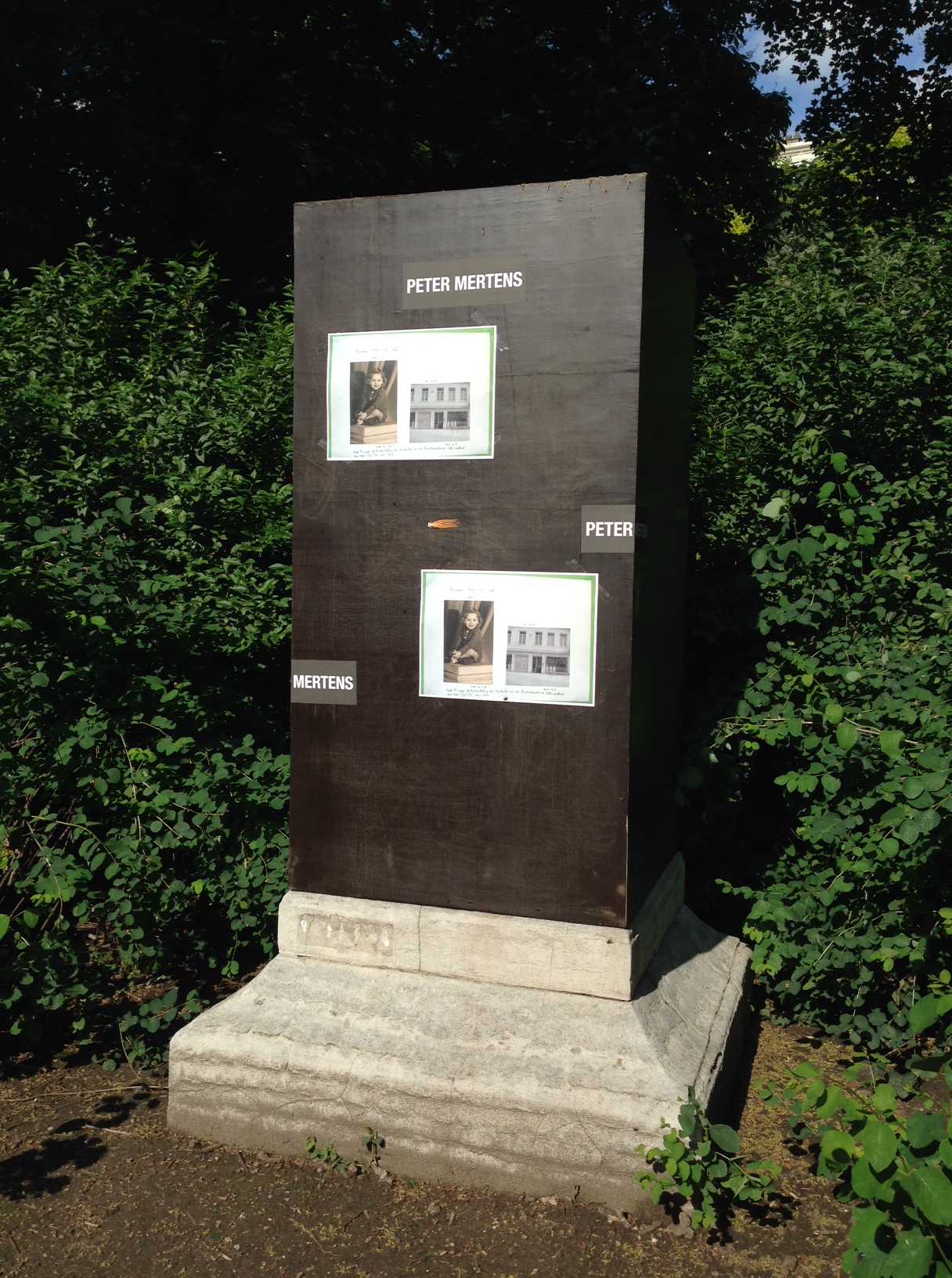
During the official inauguration, Sara Weyns, the Director of the Middelheim Museum, described it as follows: “Jef often invites others to participate by creating cooperative ventures. He brings people together who would otherwise never meet or speak, but who can each add a very personal and specific piece to the information puzzle. This is also the case here. Jef Geys has set up a cooperative venture with 508,000 residents of Antwerp and an equal number of visitors to the city. They are all invited to present their new insights on this empty plinth.”
Photos of the advertising pillar will be taken at regular intervals so that a visual diary can be made of the installation after six months. At the end of the initiative, the pillar will be transferred to the Middelheim Museum, where it will be installed permanently in its final state as a memento of the event.
‘De Sokkel’ is an initiative of the local Wijkvereniging Klein Antwerpen (Community Association Klein Antwerpen). It has been working together with the Middelheim Museum since 2011 to give a cultural emphasis to the park. Twice a year, an (inter)national artist is therefore asked to give a contemporary character to the empty plinth.
MAMA

The Middelheim Museum has taken advantage of the occasion to bring a forgotten work by Jef Geys out of storage where it has been hidden from the public for a long time. In the weeks ahead, ‘MAMA’, created in 2002, will be exhibited at its original location. The work is made up of seven rings in different types of metal that are placed around the trunks of seven old beech trees. The metal rings refer to tree rings and, by extension, to the universal theme of the passing of time and ageing. However, Jef Geys does not want to attach any univocal meaning to the work. It is for the visitors to interpret the work in their own way and create their own meaning.
The Coffee Coaster Diary
In the same way that he invited visitors and residents of the city to enter into dialogue with him through the plinth, Jef Geys has also invited the authors Joris Note and Hans Ulrich Obrist to exchange their thoughts in an issue of the ‘Kempens Informatieboek’ (De Kempen Information Book) based on his own notes and drawings. Joris Note is known for his collection of stories ‘Het uur van de ongehoorzaamheid‘ (‘The Hour of Disobedience’) (1995) and ‘Kindergezang‘ (Child Song) (1999), the novel ‘Hoe ik mijn horloge stuksloeg‘ (‘How I Smashed my Watch’) (2006) and the collection of essays ‘Wonderlijke Wapens‘ (‘Amazing Weapons’) (2012). Hans Ulrich Obrist is the director of the Serpentine Gallery in London. He has an endless list of publications to his name: ‘Do it‘(2004), ‘Everything You Always Wanted To Know About Curating * But Were Afraid To Ask‘ (2011) and ‘Conversation Series‘.
Jef Geys has invited them to react to the diary notes that he wrote on the edges of coffee coasters in a tavern in Balen. The correspondence has been compiled in the ‘Coffee Coasters Diary‘.
With their highly personal selections, insights and associations, the three authors highlight the mechanisms in the world of art and in society that are invisible to the naked eye.