ABOUT ‘OUR’ HOUSE
Jef Geys in Ter Vest in Balen
‘Because we ourselves are not a house.’
Rutger Kopland
BALEN – Friday 13 March 2015. Inauguration of replacement OCMW (social services) residential care facility, Ter Vest, in the presence of, amongst others, the mayor, the OCMW chairman and the Flemish Minister of Welfare, Health and Family.
Unusually, Jef Geys, who lives and works in Balen, is present at an event involving his work and, still more unusually, he speaks to the assembled people. He is supposed to be giving an explanation about the art project that he has created in the care facility. But Geys rarely if ever makes public declarations and certainly not about the content of his own artefacts. Therefore, he is only here in Ter Vest, typically making everyone feel uneasy, to remind us of the financial background to his artistic contribution, and emphasises that this is an obligation, not a (voluntary) ‘gift’ (from the Balen authorities). The project is part of the Flemish government’s percentage rule. He also adds that the 0.50% of the funds released under this rule does not end up ‘in his own pocket’, though it does pass through it, and will be used for a documentation centre in Balen, which won’t be built because of a lack of money (he hereby gestures to the mayor). ‘But this will help’. 1
IN SITU. The decree to which Jef Geys refers dates from 23 December 1986 and stipulates that for every construction or renovation that is partly or wholly financed by the Flemish Community, a percentage of the building costs must be spent on “artworks integrated into the building”. 2 The decree was never applied, until 1996 when a ministerial circular ordained that ‘all new applications for investment subsidies can only be declared admissible if the building plans and the specifications provide for an integrated artwork…’ In 1998 an ‘art integration’ unit was set up (renamed the ‘art unit’ in 1999), which collaborates closely with the Flemish Government Architect. The unit advises on the choice of artworks.3
In the same year two proposals by Jef Geys were selected for two ‘art integration’ projects: the Flemish Administrative Centre, the Hendrik Van Veldeken building, in Hasselt (together with Richard Venlet and Maria Blondeel) and the Provincial Government building in Leuven (together with Ann Veronica Janssens, Aglaia Conrad, Guy Rombouts, Eran Schaerf, Richard Venlet and Heimo Zobernig). After this, other designs that he submitted were also regularly selected for public buildings of various kinds: Public Psychiatric Care Centre (OPZC) in Rekem (initiated in 2000, executed in 2005), the inner area of the Turnova site in Turnhout (initiated 2012, never executed), WZC Ter Vest in Balen (initiated in 2010, executed in 2014), WZC St-Barbara in Herselt (initiated in 2012, executed in 2016).4
It is not only the quality of his work that makes Jef Geys one of the most frequently selected artists, but also the way in which he has been active from very early on in his career in the artistic world. With work that is essentially bound to time and place, in his own unique way he fitted into a major development in art in the 1960s, an indirect result of which is the abovementioned Flemish decree.
For many artists of that period, ‘in situ’ art or ‘site-specific art’ was a way of escaping the tentacles of the museum, the art market and the art consumer. They started making art that was intrinsically bound to a specific location and the environment in which it was exhibited. This made it much more difficult for the work to be consolidated via the museum network or sold on the art market. After all, it could only be presented in that specific place and lost its significance in any other location. Photos were usually the only remaining evidence of their existence. The material characteristics of a site – the contours, the dimensions, the light, the state, the function of the space, etc. – often helped define the nature of the artwork. From 1967 onwards, the works by Daniel Buren, ‘vit et travail in situ’, represent a distinct line in this trend. Buren is often said to have been the first to use the term ‘in situ’ in art.
With his deep-seated distrust of (art) institutions and (the art) trade, this development was grist for the mill for Jef Geys. But as is so often the case with him, he uses the achievements of artistic change for his own stubborn ends and pushes them to their limits. For example, the artist operates fundamentally from a situation, situating and situated in time and space. Origin and destination and the road between them are an overt part of his art process, they are explicitly shown and named.
BIOTOPE & TERROIR. The concepts of ‘biotope’ and ‘terroir’ are illuminating here. Geys himself uses them in pieces written for several exhibitions.
In 2003 the exhibition in Galerie Cum Laude in Mol was entitled ‘Biotope’. It consisted of a compilation of photos, paintings, videos, architectural plans, posters and all kinds of trinkets, all remnants of the source of inspiration that Mol (town bordering on Balen) had been in the 1960s and 1970s. Jef Geys was himself part of it and reaped the rewards. On the back of the Kempens Informatieblad (a newssheet) that accompanies the exhibition, there are descriptions of the word ‘biotope’ in German, French and Dutch: ‘Part of that section of the earth (biosphere) that is inhabited by organisms, in which living conditions are more or less equal (Gr. bios=life, topos = place)’. 5
The notion of ‘Terroir’ emerged in the Kempens Informatieblad with reference to Jef Geys’ contribution to the Venice Biennale in 2009: ‘Take ‘terroir’ as a starting point: the place where it was all able to happen or better still did happen, a little broader than ‘biotope’…6 The nub of the project was a multifaceted effort to localise plants (weeds) with healing properties in major cities: ‘What can a homeless person with toothache chew on, for example, to ease the pain, and perhaps cure it’. 7 The title ‘Quadra Medicinale’ was a reference both to the place/the square in which the plants could be found and to the ‘Leopold II quadras’ of the military camp in Leopoldsburg, the artist’s birthplace.
For Jef Geys ‘a place’ is therefore not an abstract geographical fact, not a marked-out territory, but a concrete and living piece of reality – in the ‘biotopic’ sense: bios (life) – topos (place) – where he can work and/or which he can appropriate for a short or longer period of time. Just as the terroir gives wine its taste, so place (and also time) of conception, development and implementation give form and meaning to an artwork. Close relationships with his own life and its merging with that of others are important composites of this biotope or that terroir. They guarantee the vitality.
By entering into committed partnerships with the most diverse actors – a psychiatrist, a politician, the proprietor of a cabaret bar, an industrialist, writers, journalists, schoolchildren, professors and scientists, but also with other artists, gallery owners, museum directors – for a project, and this all from his eyrie – his house/studio/archive at Langvennen 79 in Balen – and mixing them with his own private, professional and creative endeavours, he is able to protect his art from the sterile conceptualism that afflicts so much site-specific art.
For Geys, therefore, the place is and becomes clearly localised, but not fixed. As Bart De Baere writes: ‘He stands for localisation as a conscious alternative to globalisation. Localisation, which is different from ‘the local’, is performative. It is a quality of approach that makes a difference; it stands for being situated by real, complete and differentiated connections with concrete moments, spaces and persons.’ 8
HOUSE. The dimensions of a biotope are in essence not limited. In nature, it can range from a stone to a jungle. For humans, the house in which a person lives is the smallest form of biotope. This ‘house’, in the many senses of the word – as ‘construction’, as ‘someone’s home (without this necessarily referring to a building)’ or as the ‘inhabitants, the family, the family circle’ itself (Van Dale dictionary) – is one of the leitmotifs in Jef Geys’ work. A motif in which the different meanings become entangled in artworks and thus pose fundamental questions about the complex relationships between building, humans, society, culture and art.
In Jef Geys’ long artistic journey, the house was the platform for an artwork, or was even an artwork itself, or else it popped up indirectly in a project or was a central part of it.
In his 1964 Colouring book for adults, the house is one of his research topics – in addition to the world, the body, the masculine, the dream, the high priestesses of art history and things. ‘The house, the tent, the igloo, the hut, the caravan, chalet, mobile home, the place which people always mean when they say: I’m going home. When I designed the house in 1964, it was a topic of conversation, as Ladovsky had wanted: a fruitful partnership between producer (architect) and consumer (the masses).’ But Geys noticed that this was often not the case and that the house was drawn in the minutest details by the architect. ‘After months of fruitful one-way discussions, the consumer discovered that he had a free choice when it came to the letterbox.’ 9
In 1966 he produced foldable constructions ‘on a human scale, temporary, to be moved, to take away, simple. Temporary as home, permanent as sculpture, or temporary as sculpture and permanent as home.’10
A year later Geys painted his half of the two semi-detached houses black in protest at the chopping down of the tree on the boundary; the ‘Black House’ also instantly became a drawing board for his young daughter; he later painted it himself with Matisse motifs in honour of the artist.11
In 1976 he took photos of doctors’ residences in Turnhout and exhibited them in ‘De Warande’ Cultural Centre together with a map of the city on which he pinpointed the houses. ‘What is domestic culture?’ was his question, and how does that culture go from the doctor via the architect to the houses of the less well-off resident of the city? 12
In 1977 he singlehandedly built a small ‘inhabitable house’ using discarded materials. ‘When after two months I signed my autograph in the fresh cement of the threshold, did it become art at that point?’ he wondered. But it was the human content, not just the artistic quality, of his building that was important to him: ‘When I built the house, it all came back to size and the body as a unit, as in 1960 when I prudishly posed in my underpants in front of a white surface to make a series of photos and rediscovered the golden mean.’ 13
Under the drawings of his ‘Test for cardboard box inhabitants’, which appeared in the Kempens Informatieblad Alexanderpolder in 1993, he wrote: ‘Which of these drawings is a real house?’ He created the ‘Test’ as a response to a design for a ‘do-it-yourself-in-cardboard housing project for homeless people’ by pupils at a college in the Netherlands. ‘What does ‘home, house, house for the homeless’ mean?’, he wondered.14
Many of these housing and habitation questions were synthesised dialectically in the major project that Jef Geys designed for the Sao Paulo Biennale in 1991. Models (‘constructions’) of famous modernist houses in three different formats (A, B and C) were arranged on a football theme (A, display cases of national football teams), an artistic theme (B, the Biennale’s Niemeyer building) and a social environment (C, the Parque Guarini slums). In the B constructions, Jewish stars in bright (football) colours were displayed. The C construction, called ‘Casa’, was a replica of 65% of the Wintermans’ house in Balen-Mol. Inhabitants of the shanty town were given the freedom to use the life-size model or dismantle it for their own purposes. The whole concept laid bare the extremely complex web of individual, popular, political, social, cultural and artistic issues that define the relationship between humans and architecture.15
Both ‘Chalet’ and the Sao Paolo project were refused inclusion in the Oosthoek and Winkler-Prins encyclopaedias as ‘not being art’. Probably without even realising it, the two reference works had thus both understood and not understood the gist of Geys’ creations. Living/the residence/the house – a basic human need, a human right even – can indeed not be summarised in one single entry, namely art. If you want to show its complexity, you have to take an individual and social, culturally banal and ambitious, but also artistic approach to the phenomenon, and not just because of breathtaking glass walls or ingenious stair constructions. And that is what Jef Geys is forever trying to do, either separately in an artwork or simultaneously in one project.
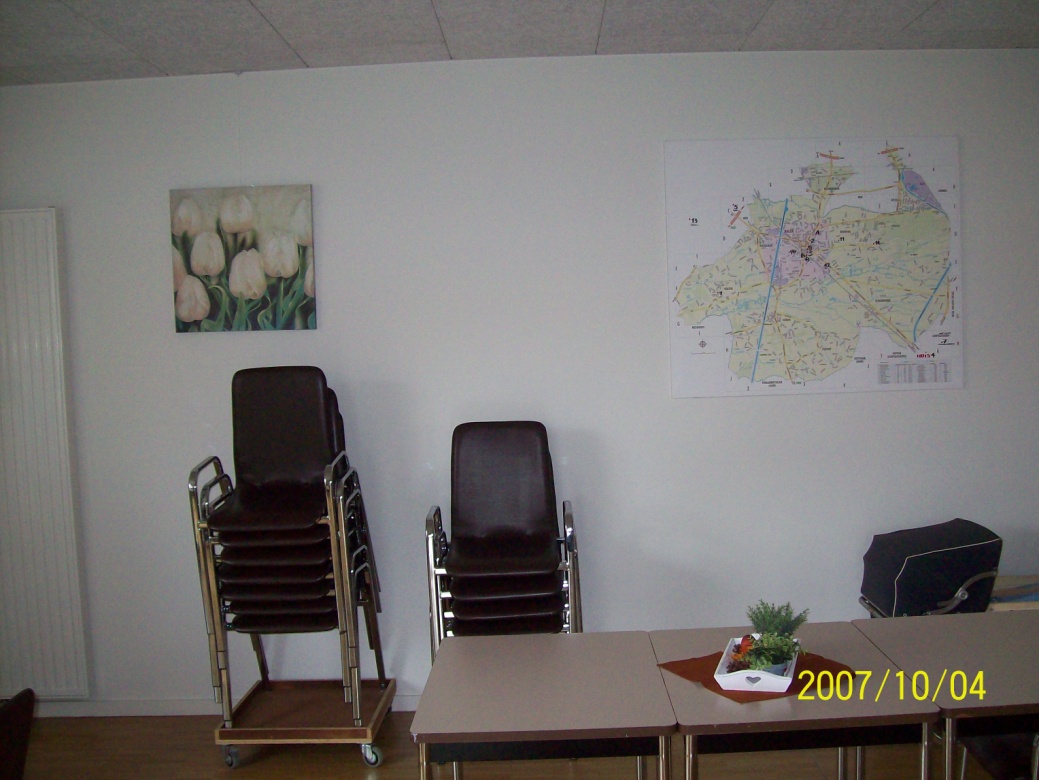
“OUR” HOUSE. The notion of the house also takes centre stage in the series of six linen canvases that the artist created in 2010 for the new care facility, Ter Vest, in Balen. But there is not one trace of a house in the work – not as a drawing, painting, photo, sculpture or model. At first glance each piece makes more of a modal, didactic impression: a street map and a table with figures and names. However, if we take a closer look at one of them, life begins to flow through this presentation. Bold numbers are written by hand on a printed street map of Balen and parts of the surrounding neighbourhoods. They indicate the homes of the residents of Ter Vest before they went to live in the care facility. At the bottom of the map a key repeats these numbers alongside the corresponding names and addresses of the residents, the numbers of their rooms in the old care facility and those of their rooms in the new facility. The layout is identical for every board in the six houses of the new WZC. They hang in the communal areas of the houses, in a different place each time (e.g. restaurant or recreation room).
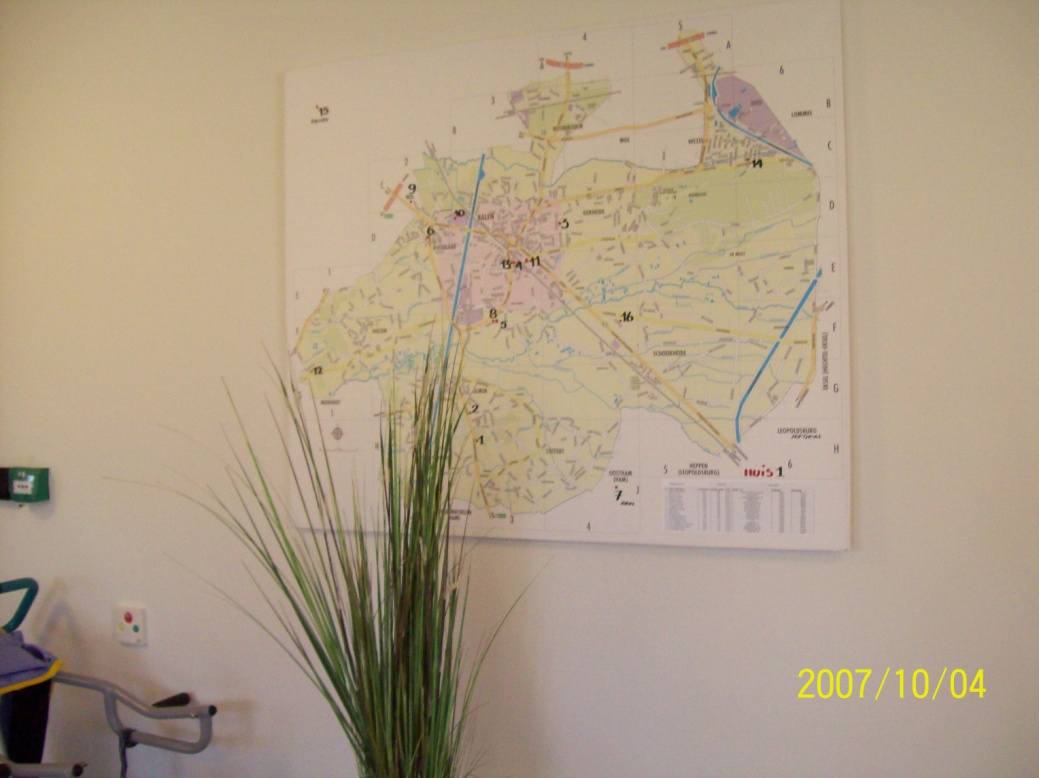
The justification of the project motivation that Jef Geys wrote in 2010 and which was published on the front page of the Kempens Informatieblad, ‘Special edition – Ter Vest- Balen’ when the centre opened in 2014, makes very clear, by his standards, the intensely existential significance that he wanted to give the maps and tables. As often happens in Jef Geys’ work, ‘a floor plan meets a real-life experience’.16 The aim of the maps is to offer the (often dementing) residents of the care facility an anchor point – a fixed point for their gradually floating awareness of time and place. They do this by orientating them, situating them in relation to their former home. The maps are an aide-memoire for the individual man or woman, but also offer an opportunity to communicate. They may give rise to the sharing of memories and (more) discussions about orientation. Who lived there? Who lived next to whom? Where did he live? … The idea is that the new house becomes more their own, becomes ‘their’ house and together with the other residents, ‘our’ house too. 17
Yet again, it shows how important orientation, situation and localisation within a living space are for Jef Geys and how intimately connected to the house.
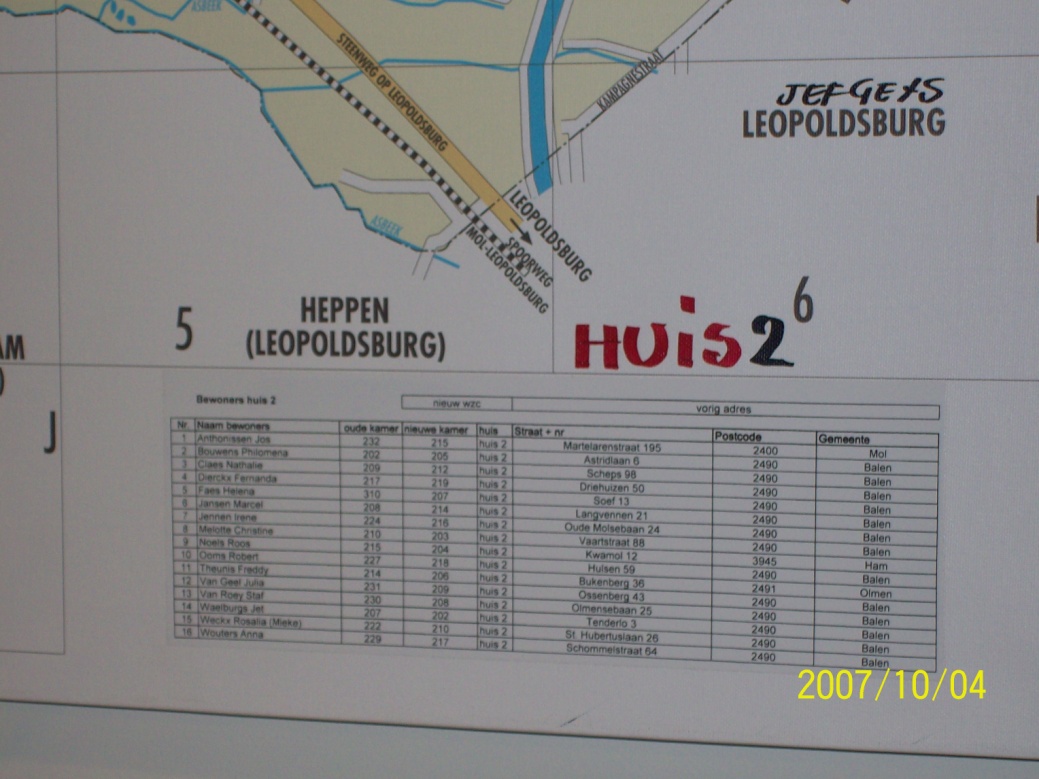
An artwork couldn’t be more ‘site-specific’. Not only is it inextricably linked to a place and the people who inhabit it, but the visual form (a street map) and the content (the localisation and orientation of the residents) also make it an immanent ‘place-bound’ work of art.
Today the works by Jef Geys have been hanging in the living areas of residents at Ter Vest for about three years. A plant, chair, table or gym equipment stands in front of them. Next to them a painting of tulips or a butterfly. They have become ‘part of the furniture’.18 But in the meantime the maps and their keys speak, not ostentatiously but like whispering witnesses:
Freddy THEUNIS
19/01/1940 – 02/09/2017
Widower of Annie LEMMENS
Husband of Marie-Jeanne MUYTJENS
retired teacher
Born in Lummen on 19 January 1940 and passed away quietly surrounded by family in house 2, “Duinroos”,
at WZC “Ter Vest” in Balen on 2 September 2017.
Philomena Bouwens died on 30 March 2017 in house 2, ‘Duinroos’, at WZC ‘Ter Vest’ in Balen. She was number 2 on the list in house 2 and lived successively at 6 Astridlaan in Balen, in the old room 202 and the new room 205; Anna Geerts died on 7 September 2017 in house 1, ‘Zonneroos’, at WZC ‘Ter Vest’ in Balen. She was number 4 on the list in house 1 and lived successively at 50 Vesstraat in Balen, in the old room 220 and the new room 114;
Freddy Theunis died on 2 September 2017 in house 2, ‘Duinroos’, at WZC ‘Ter Vest’ in Balen. He was number 11 on the list in house 2 and lived successively at 36 Bukenberg in Olmen, in the old room 214 and the new room 206;
Et cetera.19
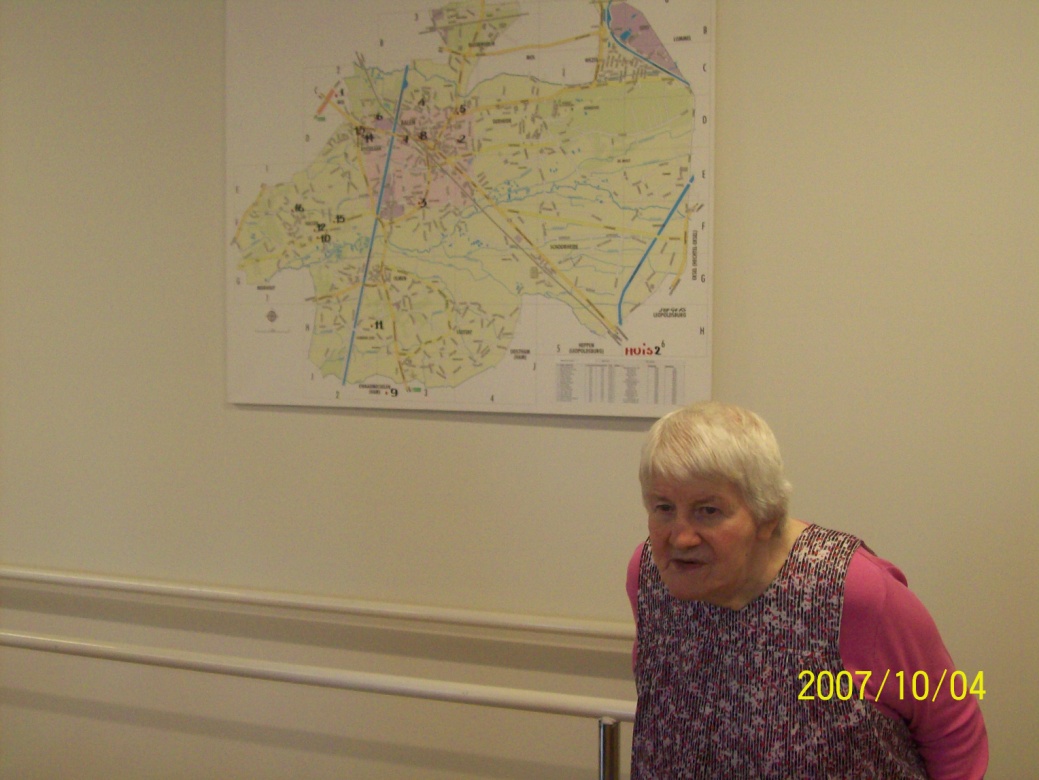
As of 4 October 2017 seven of the sixteen residents on the list in house 1 have already died, as well as eight in house 2. In a few years’ time, no-one on these lists will still be alive. The panels will then become tangible reminders of the first residents in the care facility. But for everyone who walks past a panel in the future and takes the trouble to find out the background, it will also be a poignant contemporary memento mori. Not an emblematic ‘death commemoration’ scene with a skull, hourglass, clock, dying candle… as in classical paintings, but a no less appealing reminder of death connected to real names, addresses and domiciles.
That Geys sees death also as a basis for new life is also apparent from his San Michele series, consisting of twelve montages, each of two photos of a grave in the Venetian cemetery and a dried plant growing on or next to the gravestone. The underlying idea and structure of the works are similar to those of his 2009 Biennale project Quadra Medicinale, but this was about plants/herbs connected to street scenes from major cities. What is remarkable, by the way, is that for the exhibition at ‘La Loge’ in Brussels (2017), the Kempens Informatieblad reran the edition from the Venice Biennale but included four new pages on which the twelve San Michele pieces are reproduced. 20
Even our last (resting) place is a biotope/terroir for Jef Geys (1934-….).
Bart Janssen
October 2017
Vertaling: Gregory Ball
- See also: https://vimeo.com/channels/gemeentebalen/122197994
- Decree of 23 December 1986 concerning the integration of artworks into buildings of public departments and equivalent services… published in ‘Het Belgisch Staatsblad’ on 13 February 1987, p. 2074.
- See also: Piet Coessens, Katrien Laenen and Ulrike Lindmayr, ‘Kunst in opdracht: beleid en praktijk bij Vlaamse Overheid’, in: Kunst in Opdracht 1999-2005, compiled by Katrien Laenen, Vlaamse Bouwmeester, 2006, pp. 17-83 & 311 (circular letter of 7 February 1996) and also: Kunst in opdracht 2006-2013, Kunstcel Vlaamse Bouwmeester, Brussels, 2015, p. 91.
- Ibid., pp. 88-97 & 126-133 and Het Provinciehuis, Sara Weyns, Zomer in Vlaams-Brabant. Jef Geys, in: Architectuur en Kunstintegratie, Provincie Vlaams-Brabant, 2003, pp. 36-41.
- Kempens Informatieblad for the ‘Biotoop’ exhibition at Galerie Cum Laude, Achterpad-Mol, 2003 s. p.
- Jef Geys, ‘Handleiding’, in: Kempens Informatieblad. Speciale Editie Biënnale Venetië, 2009, p. 4.
- Ibid.
- Bart De Baere, ‘Omdat we moeten praten- werelden laten gebeuren’, in: Kempens Informatieblad, Martin Douven-Leopoldsburg-Jef Geys, M HKA, Antwerp, 2011, no page number.
- Jef Geys, ‘Verhaal’, in: Jef Geys. Architectuur als begrenzing, São Paulo Biennale, 1991, no page number.
- Jef Geys, ‘Verhaal’, in: ibid.
- No. 87 in the list of all his artworks that Jef Geys regularly includes in numerous languages and sequences in the Kempens Informatieblad.
- Jef Geys, in: Kempens Informatieblad, Special Edition Warande, Turnhout, 2013, no page number.
- Jef Geys archives 2, Frans Masereelcentrum, Jef Geys, 2015, no page number.
- ‘Toets voor Slaapdoosbewoners’, in: Kempens Informatieblad, speciale Editie Alexanderpolder N°2, 9 November 1993, no page number., and Kempens Informatieblad, Venice Biennale, ibid., p.41
- See catalogue and Kempens Informatieblad, São Paulo Biennale.
- Bart De Baere, in: ibid., no page number.
- See Jef Geys, in: Kempens Informatieblad, Speciale Editie – Ter Vest, Balen, 2014, no page number.
- Nathalie Van Ginneken, coordinator of General Services, Ter Vest care facility, Balen, in a conversation at the WZC in October 2017.
- Site: http://www.inmemoriam.be/nl/#.WfmRDNThDSA
- Kempens Informatieblad, Speciale editie, La Loge, Brussels, autumn 2017, no page number.